
Can you fit a new patio in winter? Most people assume patio season ends when the clocks go back, so winter patio installation in Manchester rarely crosses their mind. People put the garden on hold and the quotes wait until March. Then everyone else has the same idea at the same time.
The truth is more useful than that. A winter build is often perfectly possible. However, it depends on two things far more than the month on the calendar: the temperature and the rain. Get those right and a patio laid in November or February can be every bit as solid as one laid in June.
Here’s how we decide whether a winter job goes ahead, what we do differently, and when we’d tell you to wait.
The short answer: yes, you can fit a new patio in winter in Manchester, as long as the air stays above 3°C while the mortar sets and the ground isn’t waterlogged. Cold, dry spells are workable. Hard frosts and days of heavy rain are not, so a good installer plans the build around the forecast rather than the date.
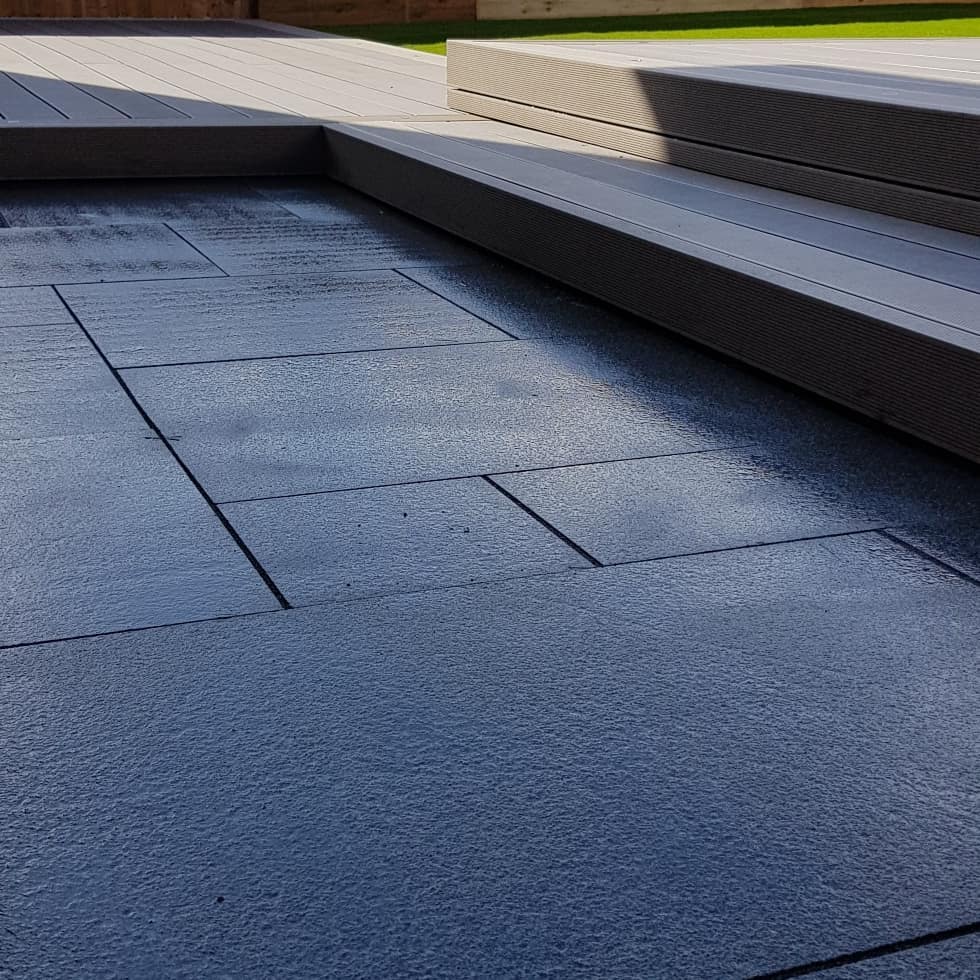
Is winter patio installation in Manchester a good idea?
For most gardens, yes. Most of the work on a new patio happens below the slabs. We dig out, lay and compact a sub-base, then bed the paving on mortar. The digging and the sub-base don’t mind the cold. In fact, a dry, crisp week can be easier to work in than a muggy one in August.
The risky part is the mortar. That’s the stage where winter weather can do real damage, so it’s the stage we plan the whole job around. Get that right, and winter patio installation in Manchester is no more risky than a summer build.
There’s also a practical upside. Your plants are dormant, the lawn isn’t growing, and you’re not losing a summer of barbecues while the garden is a building site. Once the patio is down, it’s ready the moment the weather turns.
The 3°C rule: why temperature matters more than the month
Sand and cement mortar needs warmth to set and gain strength. The Mortar Industry Association advises stopping work when the air temperature falls below 3°C. It also says to start again only once it reaches 1°C and is forecast to keep rising above 3°C.
The bit people miss is the overnight temperature. A bright winter afternoon at 7°C means very little if it drops below freezing at 3am. Fresh mortar that freezes before it hardens can lose its bond, which means loose or rocking slabs come spring.
So we check the overnight forecast as well as the daytime one. If a frost is coming, we either cover fresh work or we don’t lay that day. It’s that simple.
Manchester rain is the bigger winter problem
Cold gets the headlines, but in Manchester the rain usually causes more delays. Much of Greater Manchester sits on heavy clay soil, and clay holds water. After a wet week, the ground can turn soft and sticky. A sub-base laid on saturated ground won’t compact properly.
That matters, because a patio is only as good as what’s underneath it. A weak sub-base leads to sinking, uneven slabs and puddles that never drain. If your garden already struggles with standing water, read our guide on why Manchester gardens get waterlogged before you plan anything.
Heavy rain also washes fresh mortar out of joints and soaks the bedding layer. Light drizzle is usually manageable. Proper downpours mean we cover the work and wait.
What we check before winter patio installation in Manchester
Before we put a single slab down in winter, we run through the same checks every time.
| What we check | Why it matters | What we do about it |
|---|---|---|
| Overnight temperature | Mortar that freezes before it sets loses its bond | We don’t lay if the forecast drops below 3°C, or we cover the work |
| Ground conditions | Saturated clay won’t compact into a solid sub-base | We wait for it to drain, or sort the drainage first |
| Rainfall forecast | Heavy rain washes out mortar and joints | We plan laying days around dry spells and keep covers on site |
| Frozen materials | You can’t safely use frozen sand or sub-base | We keep materials covered and check them before use |
| Jointing product | Some jointing compounds need warmer, drier conditions | We choose a product that suits the season, or joint later |
| Daylight | Short days leave less time to finish and cover | We lay smaller sections each day |
None of this is complicated. However, it’s exactly the stuff people skip when they’re rushing to finish a job before Christmas.
Which materials suit winter patio installation in Manchester?
Most paving can go down in winter, but each material has its own quirks. Here’s what we look at when choosing them for a cold-weather job.
Porcelain is a popular choice in Manchester because it shrugs off rain and doesn’t stain easily. However, it needs a slurry primer on the back of every slab to bond to the mortar, and that primer has its own temperature limits. We check the product before we commit to a laying day.
Natural stone such as sandstone or limestone is more forgiving to lay. Even so, it’s porous, so it needs time to dry out before any sealer goes on. In winter, sealing often waits until spring.
Block paving sits on a compacted sand bed rather than wet mortar, so it’s less fussy about the cold. That said, we usually set the edging in concrete, so the same temperature rule still applies.
You can see the full range we lay on our patios and paving page, along with a recent porcelain patio we built in Timperley.
Two winter patio myths worth ignoring
Myth one: “You can’t lay a patio in winter.” You can. We lay patios between November and February. The rule isn’t about the season. It’s about the conditions on the day and the night after.
Myth two: “If it’s sunny, it’s fine.” A clear winter sky is often the warning sign. Clear nights are the cold ones, because there’s no cloud to hold the heat in. That’s why we look at the overnight low, not how nice it feels at lunchtime.
Why book winter patio installation in Manchester early?
Spring is when everyone remembers their garden. As a result, diaries fill up fast from March onwards, and you can end up waiting well into summer for a start date.
Booking a winter patio installation in Manchester gets you ahead of that queue. We agree your design, order your materials, and the patio is ready for the first warm weekend of the year. Meanwhile, the ground is quieter, your borders are dormant, and any lawn repairs around the edges have all spring to recover.
If you’re also thinking about wider changes, our landscaping service covers everything from new lawns to raised beds, so we can finish the whole garden in one go.
Winter patio installation Manchester FAQs
Can you lay a patio in the rain?
Light drizzle is usually fine, but heavy rain isn’t. It washes cement out of the bedding and joints, and it softens the ground underneath. A good installer covers fresh work and moves laying days around the forecast, rather than pushing on through a downpour.
What temperature is too cold to lay a patio?
As a rule, don’t lay sand and cement mortar when the air is below 3°C. Only restart once it reaches 1°C and is forecast to rise. Check the overnight low too, because fresh mortar can still freeze hours after the slabs look finished.
Will a patio laid in winter crack?
Not if it’s laid properly. Cracks and loose slabs usually come from mortar freezing before it sets, or from a weak sub-base on waterlogged ground. Both are avoidable with the right checks, decent covers and a bit of patience with the weather.
How long does winter patio installation in Manchester take?
It depends on the size of the patio and the weather. Winter days are shorter, and we’ll lose some days to frost or heavy rain. So a job can take longer than it would in summer. We’ll give you a realistic timeline at quote stage, with the weather built in.
Is porcelain OK to lay in cold weather?
Yes, as long as the temperature suits the mortar and the slurry primer. Porcelain itself handles frost and rain very well once it’s down. The care is all in the laying, so choose an installer who checks the product limits before each laying day.
Thinking about a new patio this winter?
If you’d like your patio ready for spring, now is a good time to talk. Get in touch with The Manchester Landscaping Company for a quote, or call us on 0161 222 4465.